Understanding AI Project Challenges
Most enterprise AI projects fail not because of bad models, but because companies try to jam AI into rigid IT systems. Learn how a brain-inspired architecture—filters, agents, and orchestration—can reverse the 90% failure rate.
The AI Paradox Everyone Is Ignoring
Artificial intelligence is everywhere. If you work in IT or software development, you've either already encountered AI or will soon be involved in an AI project. The current hype is impossible to ignore, but it obscures a critical reality.
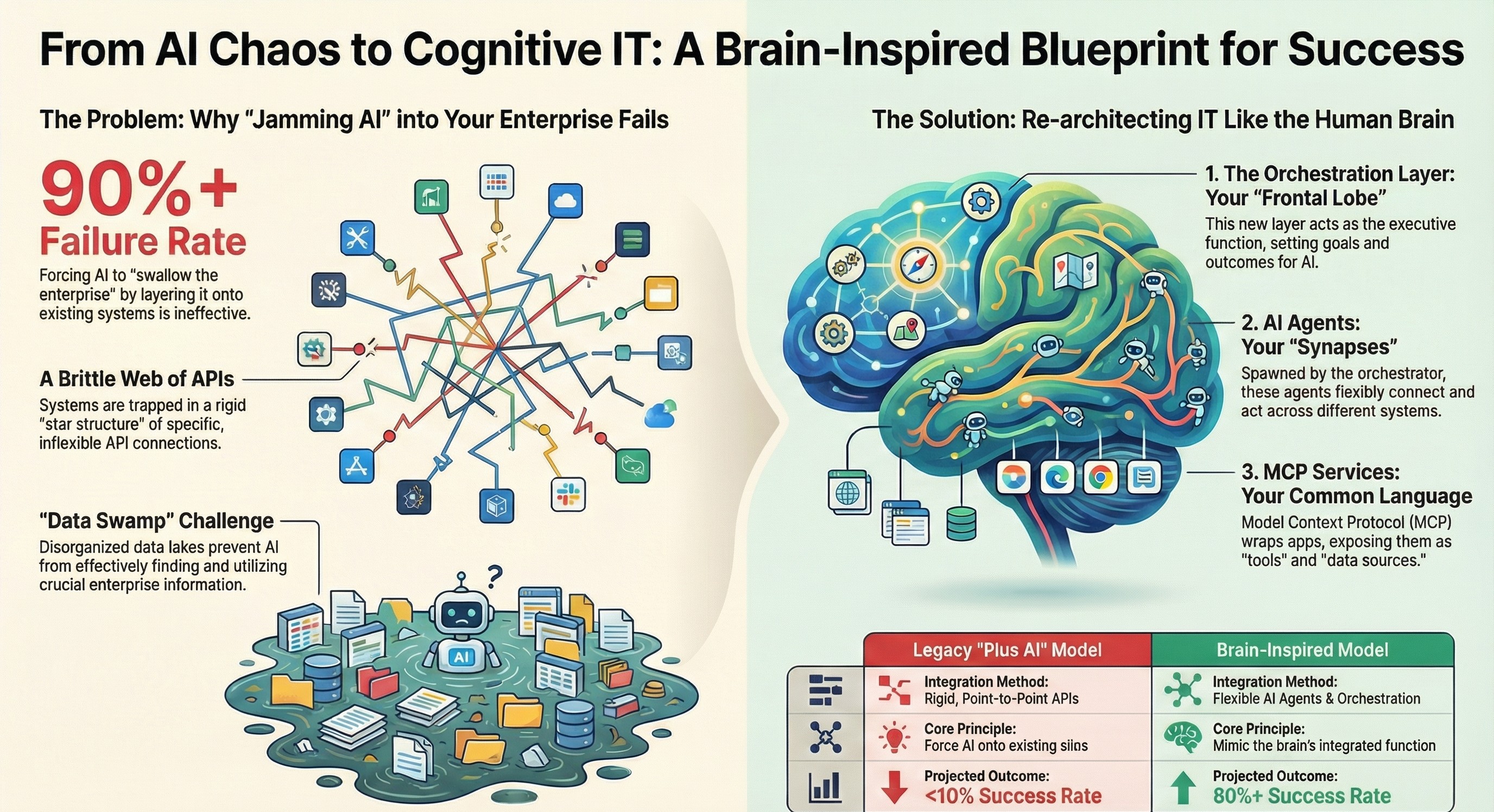
The dominant approach of "jamming" AI into existing enterprise IT structures is failing spectacularly. While companies invest heavily to infuse their operations with intelligence, they're hitting a wall. A shocking 90% or more of AI initiatives implemented in this style do not succeed.
The solution, however, isn't found in more code, bigger data sets, or faster processors. The key to building successful enterprise AI is counter-intuitive: we must stop thinking like IT architects and start mimicking the architecture of the most successful intelligence system ever created—the human brain.
---
1. The Problem: We're Forcing AI to "Swallow the Enterprise"
What's happening: Companies are trying to replicate the success of large language models by forcing AI to consume their entire enterprise infrastructure.
Why it fails: Generic internet data is vastly different from the specific, contextual, and proprietary data an organization cares about.
The approach: Jamming AI capabilities into rigid, pre-existing IT infrastructures composed of disparate applications, siloed data, SaaS platforms, and complex networking.
Real example: A Fortune 500 company spent $50 million implementing an AI system by connecting it to every existing database and application. The AI couldn't distinguish between critical customer data and routine system logs. It became overwhelmed with noise, provided inconsistent answers, and was abandoned within 18 months.
The "jamming" approach lacks the necessary organization and separation of concerns to handle specialized information effectively. The result? Systems that are chaotic, inefficient, and ultimately ineffective.
> "We're trying to have AI swallow the enterprise... The problem with this is that we're seeing 90% plus failure of AI initiatives that are happening in this style."
Why it matters: Without a fundamental shift in architecture, throwing more resources at AI projects just means more expensive failures. The goal of a brain-inspired architecture is to reverse this trend and target an 80%+ success rate.
---
2. The Blueprint: Your Brain's Three-Part Architecture
What it is: The human brain's "body plan"—what an IT person would call its architecture—provides a proven blueprint for building successful AI systems.
Key principle: The brain isn't a single, monolithic processor; it's a highly organized, compartmentalized, and integrated system.
Goal: Build AI systems that mirror the brain's specialized yet integrated structure.
The three-part organization:
Lower Brain: Manages primitive data processing and responses. Think of it as your system's sensors and basic monitoring—body temperature, touch responses, automatic reflexes. In enterprise terms, this handles routine data ingestion and basic system health checks.
Midbrain: Acts as the central connectivity hub, handling data exchange, memory storage, and communication between specialized regions. This is your enterprise's data integration layer, routing information where it needs to go.
Upper Brain: The massive region dedicated to higher-level functions. It includes the frontal lobe for executive functioning (the "pilot"), specialized areas for sensory processing (auditory, visual), and capacity for long-term, strategic thinking. In business terms, this is where complex decisions happen—strategy, planning, problem-solving.
Real example: When you recall a day at the beach, you don't just access a data point. You integrate the salt smells, the sound of waves, the taste of crab cakes, and even the memory of stepping on a sharp shell. Multiple specialized brain regions activate simultaneously and synthesize their outputs into a coherent experience.
Why it matters: This organized, compartmentalized, yet deeply integrated system is the complete opposite of the chaotic "jam it in" approach failing in enterprise IT today. The brain's architecture has evolved over millions of years to be efficient, reliable, and scalable.
---
3. The Filter: Your AI Must Ignore 99.8% of Everything
What it does: The brain actively ignores approximately 99.8% of all sensory data it receives at any given moment.
Who benefits: Organizations drowning in data lakes that have become data swamps.
Goal: Build AI systems that ruthlessly filter noise and flag only what's strategically important.
Real example: Consider your daily commute. Your brain knows other cars are on the road, but it automatically filters out irrelevant details—the specific make, model, and color of every vehicle you pass.
But if a bright red Ferrari suddenly speeds by? Your brain flags that event as out of the ordinary and might commit it to memory. Why? Because anomalies often signal important information.
In enterprise terms: Your AI should ignore routine transactions (99.8% of data) but immediately flag:
- Unusual purchase patterns that might indicate fraud
- System performance anomalies that could predict failures
- Customer behavior changes that suggest churn risk
- Supply chain disruptions before they cascade
Why it matters: Current systems often attempt to process everything, creating "data lakes" that quickly become data swamps—flooded with irrelevant noise. An effective AI system must not only ignore the mundane but must also be expertly tuned to identify, flag, and retain anomalous or strategically important events.
The lesson: Intelligence isn't about processing more data. It's about knowing what to ignore.
---
4. The Mechanism: From Rigid APIs to AI Agents
What changes: Moving from brittle, highly specific APIs to dynamic, intelligent communication between AI agents.
Who performs it: AI architects and system designers, working with development teams.
Goal: Create an enterprise brain that can adapt, learn, and respond intelligently to complex business challenges.
The old way: Traditional IT is built on a rigid "star structure" where core applications (CRM, HRIS, financials) are connected by brittle, highly specific APIs. This architecture is fragile—if you leave anything to chance, things break.
The new way: A brain-inspired model with three core components:
Orchestration Layer: This is your enterprise's new "frontal lobe." It doesn't perform tasks itself. Instead, like the brain's executive function, it operates by defining "goals and acceptable outcomes," then activating other components to achieve them.
AI Agents: These are the new "synapses" of your enterprise brain. The orchestration layer spawns armies of these specialized agents to carry out complex tasks, communicating and collaborating across the entire system.
Model Context Protocol (MCP): This is the new communication standard, replacing rigid APIs. MCP exposes applications and data sources not as fixed endpoints, but as collections of "tools" (what I can do) and "data sources" (what I know). This allows AI agents to intelligently discover and utilize the exact capabilities needed for a given task.
Real example: A customer calls about a delayed shipment. In the old system, a support agent manually checks CRM, inventory, shipping, and billing systems—each with separate logins and interfaces.
In the brain-inspired system:
- The orchestration layer receives the goal: "Resolve customer's shipment issue"
- It spawns specialized AI agents that simultaneously:
- Agents collaborate to propose solutions
- The system resolves the issue and updates the customer—often before the support agent finishes typing
Why it matters: This architecture enables your enterprise to function like a brain. The CRM functions like the auditory center (listening to customers), the financial system like the strategic frontal lobe (planning and analysis), and the orchestration layer coordinates everything.
---
5. Integration: Making All Parts Work as One System
What it tests: Whether your compartmentalized AI systems can work together seamlessly to solve complex business problems.
Who performs it: Enterprise architects, AI teams, and business stakeholders working together.
Goal: Achieve the brain's "million-dollar feature"—integrating data from all specialized parts into a coherent whole.
Real example: A retail company implements the brain-inspired architecture:
- Lower brain: Monitors store sensors, website traffic, inventory levels
- Midbrain: Routes data between systems, maintains shared memory
- Upper brain: Makes strategic decisions about pricing, promotions, inventory
During a holiday sale, the system:
- Detects unusual traffic patterns (lower brain)
- Retrieves historical sale data (midbrain memory)
- Analyzes competitor pricing in real-time (upper brain)
- Adjusts pricing dynamically (executive function)
- Allocates inventory across stores (coordination)
- Predicts and prevents stockouts (strategic thinking)
All of this happens automatically, in seconds, across thousands of products and dozens of stores.
Common integration pitfalls:
- Systems work individually but can't share context
- Data flows one way but feedback loops don't exist
- Agents can't coordinate on complex, multi-step tasks
- Executive function (orchestration) lacks visibility into specialized systems
Why it matters: Integration is what separates a collection of AI tools from an intelligent enterprise. The brain's power comes from integration, not individual parts.
---
6. Validation: Ensuring Your AI Brain Makes Good Decisions
What to validate: Whether your brain-inspired AI system makes better decisions than traditional approaches.
Who performs validation: Business leaders, data scientists, and end users—everyone with a stake in outcomes.
Goal: Prove that the new architecture delivers measurable improvements in business metrics.
Key metrics to track:
- Decision quality: Are AI recommendations better than human-only decisions?
- Response time: How fast can the system identify and address issues?
- Error rates: Are mistakes decreasing as the system learns?
- Business impact: Revenue, cost savings, customer satisfaction improvements
- Adoption rates: Are people actually using the system or working around it?
Real example: A healthcare network implements a brain-inspired AI for patient care coordination. They validate by comparing:
- Before: 15% of patients had care plan conflicts, average resolution time 4 days
- After: 2% conflict rate, average resolution time 6 hours
- Validation: System correctly identified and resolved 87% of issues autonomously
Why it matters: You can't improve what you don't measure. Validation ensures your brain-inspired architecture actually works better than what it replaced. Without validation, you're just replacing one expensive failure with another.
---
7. Evolution: Your AI Brain Must Learn and Adapt
What it means: Like the human brain, your AI architecture must continuously learn from experience and adapt to new challenges.
Who manages it: A dedicated team combining data scientists, domain experts, and business analysts.
Goal: Create a system that gets smarter over time, not just bigger.
How brains learn:
- Pattern recognition: Identifying recurring situations and optimal responses
- Error correction: Learning from mistakes and adjusting behavior
- Memory consolidation: Moving important information from short-term to long-term storage
- Pruning: Eliminating unused connections to maintain efficiency
Real example: A financial services company's AI brain:
- Month 1: Flags 1,000 potentially fraudulent transactions, 60% accuracy
- Month 6: Flags 500 transactions, 85% accuracy (learned to filter better)
- Month 12: Flags 300 transactions, 94% accuracy (continuously refining)
- Improvement: Not only more accurate, but also more efficient—processing 99.8% of transactions automatically while focusing attention on genuine threats
Why it matters: Static AI systems become outdated quickly. Brain-inspired systems that learn and adapt maintain their value over years, not months. The initial investment pays dividends as the system gets continuously better.
---
How These Elements Work Together
Think of building an AI brain as creating layers of intelligence:
The filtering layer (99.8% rule) ensures only relevant data reaches higher functions.
The compartmentalization (three-part brain) gives specialized systems clear responsibilities.
The integration layer (brain's million-dollar feature) connects everything into a coherent whole.
The communication protocol (MCP and AI agents) replaces rigid APIs with intelligent messaging.
The orchestration layer (frontal lobe) defines goals and coordinates specialized systems.
The validation process proves the system works better than alternatives.
The evolution mechanism ensures continuous improvement.
Each element builds on the others. Skip one, and the system remains just another collection of tools. Implement them all, and you create true enterprise intelligence.
---
Common Questions About Brain-Inspired AI
Q: Isn't this just microservices architecture with a new name? No. Microservices focus on technical decomposition. Brain-inspired architecture focuses on functional intelligence—how systems think, decide, and learn. The communication patterns are fundamentally different.
Q: How long does it take to implement this approach? Start small. Pick one complex business process and build a brain-inspired solution. Most organizations see results within 3-6 months for a single use case, then expand from there.
Q: What about our existing systems? You don't need to rip and replace. The orchestration layer sits above existing systems, using AI agents and MCP to intelligently coordinate them. Legacy systems become "organs" in your enterprise brain.
Q: Isn't this expensive? Less expensive than your current 90% failure rate. Start with high-value use cases. The efficiency gains from the 99.8% filtering rule alone typically cover implementation costs.
Q: Do we need special AI expertise? You need people who understand both business processes and AI capabilities. Often, your best enterprise architects can learn this approach. The key is shifting mindset from "connecting systems" to "building intelligence."
---
Tips for Building Your Enterprise AI Brain
Start with one complex problem. Don't try to "AI-enable" everything at once. Pick a high-value, complex business process and build a brain-inspired solution for it.
Map your current "brain." Identify what functions as your lower brain (sensors/monitoring), midbrain (data flow/memory), and upper brain (strategic decisions). Most organizations discover they lack proper orchestration.
Implement the 99.8% rule first. Before building new AI, implement intelligent filtering on existing data. This alone often provides breakthrough insights and efficiency gains.
Invest in orchestration. Most companies over-invest in specialized AI tools and under-invest in the orchestration layer that makes them work together intelligently.
Measure continuously. Track decision quality, response times, error rates, and business impact. Use these metrics to guide evolution.
Think in decades, not quarters. Brain-inspired architecture is an investment in long-term competitive advantage, not a quick fix. Plan for continuous evolution.
Build cross-functional teams. Your AI brain team needs domain experts, data scientists, architects, and business leaders. No single discipline can do this alone.
---
The Bottom Line
To reverse the 90%+ failure rate of AI initiatives, we must fundamentally shift our thinking. Stop jamming monolithic AI into rigid IT systems. Instead, redesign your systems to function like a brain—an architecture that is:
✅ Integrated: All parts work together seamlessly ✅ Compartmentalized: Specialized components handle specific functions ✅ Ruthlessly efficient: 99.8% of noise filtered out ✅ Continuously learning: Gets smarter over time ✅ Low-power: Maximum intelligence with minimal resources
By embracing orchestration layers, intelligent agents, dynamic communication protocols, and strategic filtering, we move from systems that merely store data to systems that can truly think.
The question for your next AI initiative isn't "What can AI do for us?"
The real question is: "Is our IT architecture ready to think?"
That answer determines whether you join the 90% who fail or the 10% who succeed. The human brain solved the intelligence problem millions of years ago. Now it's time to apply those lessons to enterprise AI.
Your move. Will you build an IT system or a brain? 🧠