What Is the Deep Web? 5 Things You Need to Know About the Hidden Internet
95% of the internet is hidden from Google. Learn what the Deep Web really is, how Tor works, why it's not all illegal, and how to stay safe online.
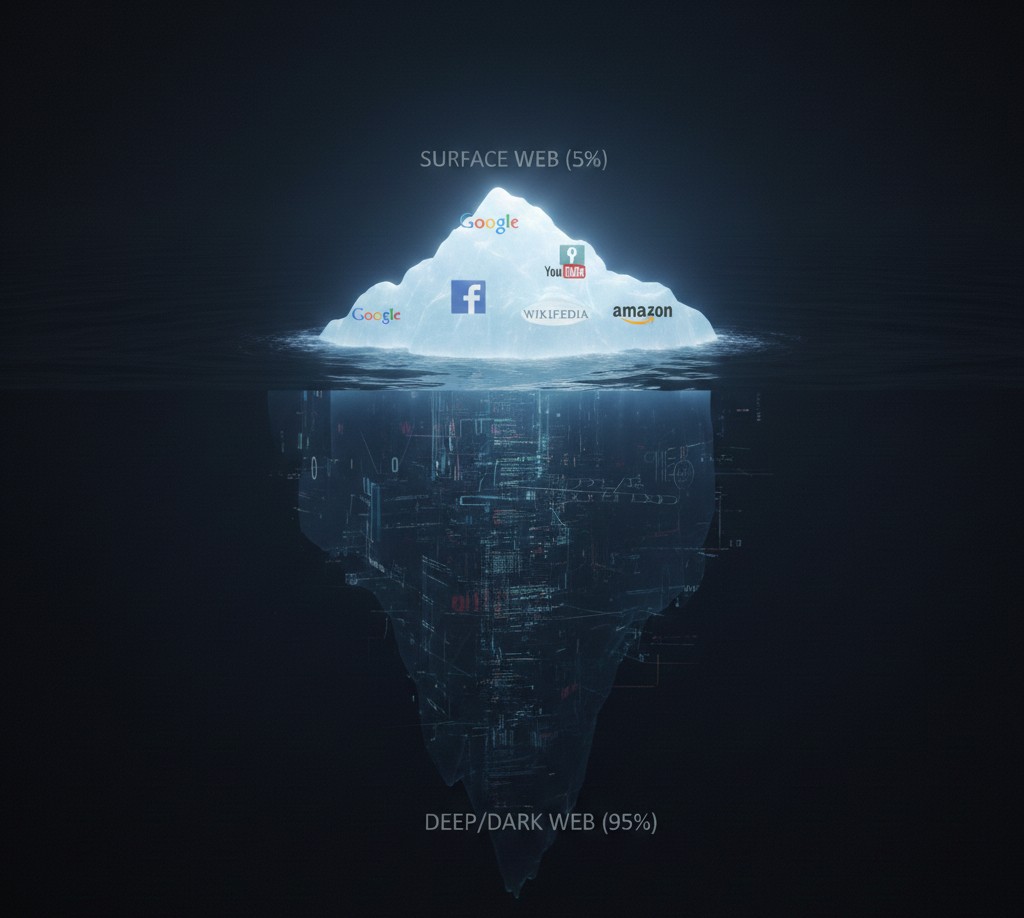
You think you know the internet. You scroll through social media feeds, stream video on demand, and search for answers to every random question that pops into your head. But here's the uncomfortable truth: you've been living on the surface of a massive digital ocean this entire time. The "Surface Web" (Google, Facebook, YouTube, everything you can find through a search engine) represents roughly 5% of the total internet. The other 95% exists below the waterline, completely invisible to your browser and unreachable through traditional search. Most people have no idea this hidden layer exists. Those who do usually get it completely wrong.
Thing 1: The Deep Web is Boring (And That's a Good Thing)
Let's clear up the biggest misconception first. The terms "Deep Web" and "Dark Web" are not interchangeable. They represent completely different things. The Deep Web makes up the vast majority of that hidden 95%, and it's not some criminal underworld. It's essentially the internet's digital filing cabinet. Password-protected content, encrypted databases, private forums, internal company systems. All technically part of the Deep Web. Your email inbox? Deep Web. Your online banking portal? Deep Web. Your medical records stored in a hospital database? Deep Web. This isn't a bug. It's a fundamental requirement for digital privacy. Without the Deep Web keeping this content hidden, your most sensitive personal information would be one Google search away from public exposure.Why This Matters
The media loves to conflate "hidden" with "sinister," but the reality is far more mundane. The overwhelming majority of the Deep Web is just properly secured private data doing exactly what it should be doing: staying private. > "The Deep Web isn't a dark underworld. It's just the internet doing its job: keeping your private life private." What this means: Understanding the Deep Web helps you appreciate that privacy-by-design isn't suspicious. It's the only reason your digital life isn't completely exposed to anyone with an internet connection.Thing 2: It's Not Just for Villains (The Anonymity Paradox)
Now the Dark Web is a different story. This is where the headlines come from, and they're not entirely wrong. It does host marketplaces for contraband, stolen credentials, and malware-as-a-service. Cybersecurity researchers actually monitor these markets like stock tickers, tracking the going rate for hacked databases and compromised accounts. But here's what those headlines always miss: the technology that shields criminals also serves as a lifeline for the vulnerable. The Dark Web prioritizes total anonymity above everything else. That makes it invaluable for whistleblowers exposing corruption, journalists operating in authoritarian regimes, and political activists in countries where free speech can get you killed. This creates what security experts call a "dual-use paradox." The exact same technology enables both illegal marketplaces and critical human rights work. You can't eliminate one without destroying the other. As IBM's cybersecurity division puts it: > "The Dark Web, again, is a place where there can be good things that happen. There can be bad things that happen. It's a dual-use technology."The Legitimate Use Cases
Whistleblowers: Exposing government or corporate corruption without ending up in prison (or worse) Journalists: Communicating securely with sources in countries where investigative journalism is illegal Activists: Organizing protests and sharing information in authoritarian states Citizens: Accessing uncensored news and information when their government controls the entire internet What this means: The tool that enables drug markets also enables the free press in dozens of countries where journalism is punishable by death. Technology itself is neutral. Context determines whether it's used to harm or help.Thing 3: Your Connection is an Onion (The DOD Origins of Tor)
To access the Dark Web, you need specialized tools. The most widely used is Tor (The Onion Router), and its origin story is more official than you'd expect. Tor originated within the U.S. Department of Defense in 1995 as a way to protect intelligence communications. It was later handed off to the Electronic Frontier Foundation and released as open-source software. So yes, the go-to tool for anonymous browsing was literally created by the military. The "Onion" metaphor describes how it works. Your data gets wrapped in multiple layers of encryption. But the genius isn't just encryption. It's how the network routes your traffic. Before you send anything, your Tor browser contacts a Directory (basically a phone book for the network). This directory provides addresses for volunteer-run relay nodes scattered around the world. Your connection then bounces through three specific nodes: The Entry Node: Your first hop into the network. Knows your real IP address but not your destination. The Middle Node: The relay point. Knows neither your identity nor your destination, just that it needs to pass data along. The Exit Node: The final hop before reaching your destination. Knows where you're going but not who you are. Each node only "peels" one layer of encryption to reveal the address of the next hop. No single node ever sees the full picture. The Entry Node can't see your destination. The Exit Node can't see your origin. The Middle Node sees neither.How This Protects You
The architecture makes it nearly impossible to trace activity back to the source:- Your ISP sees you connecting to Tor, but not what you're doing
- The Entry Node sees your identity but not your destination
- The Middle Node sees neither
- The Exit Node sees your destination but not your identity
- The destination server sees a request from the Exit Node, not from you
Thing 4: The "Exit Node" Vulnerability
Here's where most people get Tor wrong. They assume it provides absolute, end-to-end anonymity. This is a technical misconception that can get you compromised. Tor encrypts your path through the network. But once your traffic leaves that final Exit Node to reach the destination server, it is "in the clear." If you're not using application-level encryption (like HTTPS), your data is completely exposed at this point. Even worse, the entire network runs on volunteer nodes. There's no vetting process. Anyone can run an Exit Node, including bad actors specifically looking to intercept unencrypted traffic. Some government agencies have been caught running Exit Nodes for exactly this reason. The final leg of your journey is often the most dangerous.Real-World Consequences
Without HTTPS: Login credentials transmitted in plain text can be harvested at the Exit Node Malicious operators: Some Exit Nodes are run specifically to collect unencrypted data passing through them Traffic correlation: Sophisticated adversaries can still use timing analysis to correlate traffic patterns, even if they can't read the content > "Tor protects your route, not your content. If you're not using end-to-end encryption, you're exposed exactly where it matters most." What this means: Tor is one layer of protection, not a complete security solution. Always use HTTPS. Always assume the Exit Node might be compromised. Never rely on Tor alone to keep you safe.Thing 5: The "Belt and Suspenders" Security Stack
Walking into the Dark Web without proper protection is like walking through a rough neighborhood at 3 AM wearing a Rolex. The risks (automated malware, phishing sites, network-level exploits) are constant and aggressive. To survive, you need what security professionals call a "belt and suspenders" philosophy. If one layer fails, the next one catches you before your pants fall down. Because the Tor Exit Node leaves you exposed, you need to rebuild end-to-end protection through defense in depth. Here's what an expert-level setup looks like:Layer 1: Virtual Private Networks (VPNs)
VPNs add the end-to-end encryption that Tor lacks, creating an encrypted tunnel from your device to the VPN server before your traffic even enters the Tor network. Best practice: Connect to your VPN first, then launch Tor (Tor-over-VPN configuration). This way your ISP can't even see that you're using Tor, and the Entry Node can't see your real IP address.Layer 2: Security Sandboxes
Run your browser inside an isolated environment. If a malicious site forces a malware download, the infection gets trapped in a digital cage and cannot reach your primary operating system. Implementation options: Virtual machines (VirtualBox, VMware), containerized browsers (Docker), or dedicated sandboxing software (Sandboxie, Firejail). For maximum security, run a VM inside your host OS and only use Tor inside that VM.Layer 3: Firewalls
Configure your firewall as a sentry, explicitly denying all outbound traffic except through your VPN and Tor connections. This prevents any malware that does get through from phoning home to its command-and-control server. Configuration tip: Use application-level firewall rules that whitelist only your VPN client and Tor browser. Everything else gets blocked by default.Layer 4: Operating System Hardening
Security-focused operating systems designed specifically for this use case. Tails (The Amnesic Incognito Live System) routes everything through Tor by default and leaves no trace on the host machine. Qubes OS compartmentalizes every application into isolated virtual machines. What this means: Real operational security isn't about finding one perfect tool. It's about layering multiple imperfect tools so that when one fails (and eventually something will fail), the others catch the attack before it reaches you. ---Awareness Without the Risk
The Dark Web represents a complex technological frontier that balances the human right to anonymity against the reality of a lawless digital space. It is territory that is certainly not for the "technologically faint of heart." Beyond the technical complexity, there are genuine legal risks. In some jurisdictions, simply accessing these networks can be illegal regardless of what you do there. But here's the good news: you don't need to personally explore these spaces to benefit from understanding them. Organizations like IBM's X-Force and other threat intelligence teams monitor these networks constantly, tracking emerging attack patterns and compromised credentials so that regular users can stay safe on the surface web. As we build our digital lives on the 5% of the internet we can see, we need to grapple with the reality of the 95% we can't: How do we balance the absolute necessity of digital anonymity for some with the inherent risks of a space that exists beyond the reach of the law?What You Should Do About It
For Privacy-Conscious Users
- ✅ Use encrypted messaging apps: Signal and WhatsApp use end-to-end encryption by default
- ✅ Force HTTPS everywhere: Browser extensions like HTTPS Everywhere prevent unencrypted connections
- ✅ Choose a reputable VPN: Look for independently audited no-logs policies and strong encryption standards
- ✅ Practice password hygiene: Use a password manager (Bitwarden, 1Password) and enable two-factor authentication everywhere possible
For Tech Professionals
- ✅ Understand the underlying architecture: Know how Tor, VPNs, and encryption protocols actually work at a technical level
- ✅ Monitor Dark Web exposure: Use threat intelligence platforms to check if your organization's data has appeared on Dark Web markets
- ✅ Educate your team: Most security breaches start with human error, so train colleagues on privacy tools and their limitations
- ✅ Design for privacy: Build systems with end-to-end encryption by default, not as an afterthought
For Everyone
- ✅ Keep learning: Privacy threats evolve constantly, and yesterday's best practices become obsolete fast
- ✅ Support digital rights: Advocate for strong encryption standards and push back against government backdoor proposals
- ✅ Question unnecessary surveillance: Challenge data collection practices that go beyond legitimate needs
- ✅ Protect what you have: Once your privacy is compromised, you can't get it back
The Bottom Line
The hidden internet isn't one monolithic dark underworld. It's a spectrum ranging from your password-protected email to anonymous networks where journalists and criminals operate side by side. You don't need to visit these spaces to understand them. You need to understand why they exist, who needs them, and how the underlying technology works. The Deep Web protects your private data from becoming public. The Dark Web protects anonymous communication from being traced. Both are essential for a functioning digital society. Both come with serious risks that demand informed respect. Privacy isn't dead yet. But protecting it requires knowledge, proper tools, and constant vigilance. The real question isn't whether the hidden internet should exist. It's how we navigate the permanent tension between privacy and security in a world where both are under relentless attack. Which layer will you start exploring first? 🔒Found this useful?
Save it for later or share it with someone who might need it.
Discussion
Share your thoughts on this article.
Loading comments...