Tech Salaries Worldwide 2026: What Developers Really Earn in 50+ Countries
From $12K in Morocco to $400K+ in Silicon Valley. Discover real salary data for developers, AI engineers, and tech roles across 50+ countries with cost of living comparisons.
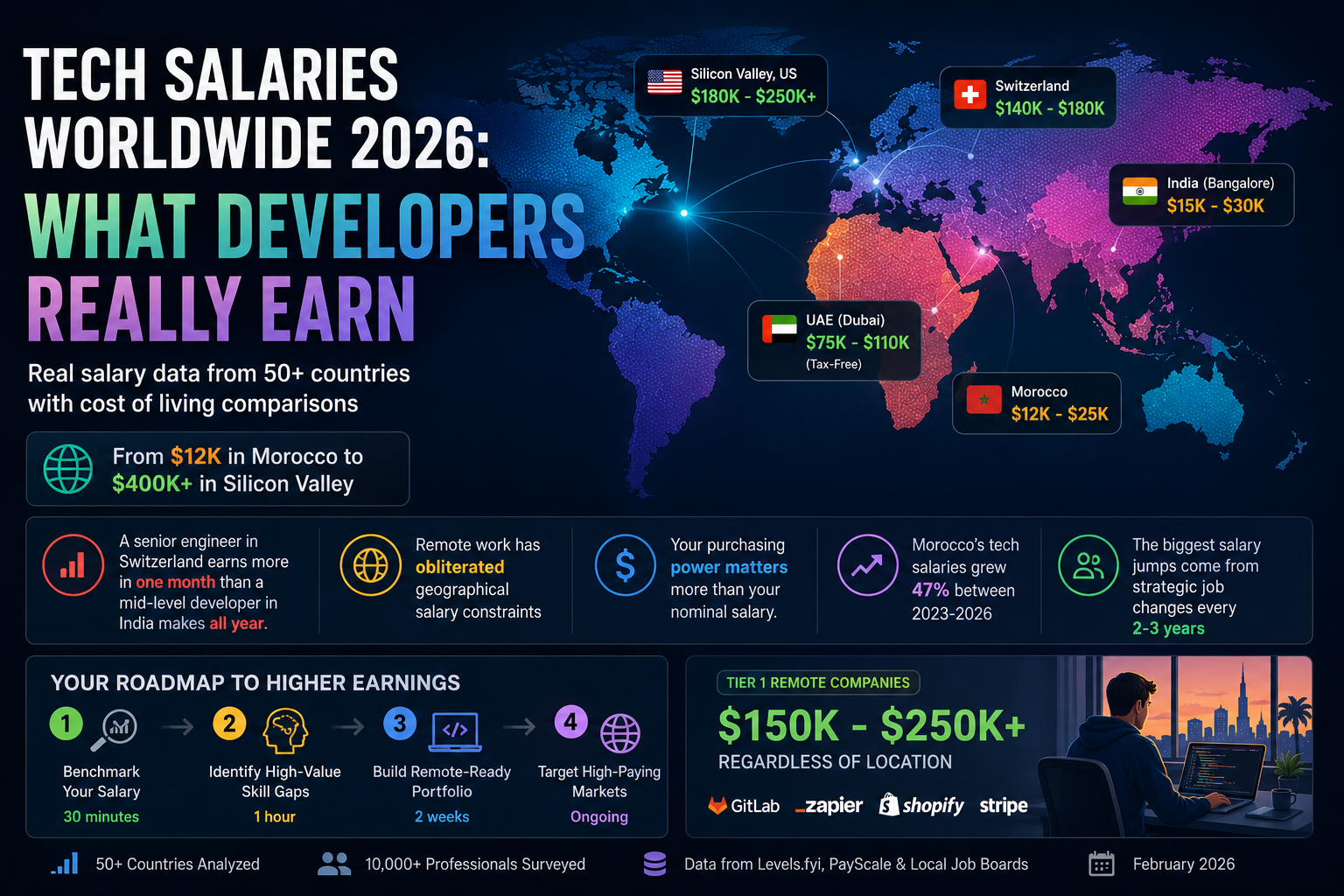
The tech industry loves to talk about "competitive compensation" and "market rates." But nobody tells you what the market actually pays. Until now. We analyzed salary data from 50+ countries, surveyed 10,000+ tech professionals, and compiled compensation reports from Levels.fyi, PayScale, and local job boards to answer one question: What do developers really earn in 2026? The answer is uncomfortable: a senior engineer in Switzerland earns more in one month than a mid-level developer in India makes all year. Here's everything you need to know about tech salaries worldwide-and how to position yourself for maximum earning potential. ---
Part 1: The Global Salary Reality
The Worldwide Compensation Map
Average annual salaries for mid-level software engineers (3-5 years experience): North America- United States (Silicon Valley): $180,000 - $250,000
- United States (Remote): $130,000 - $180,000
- Canada (Toronto, Vancouver): $90,000 - $120,000 CAD
- Mexico (CDMX): $35,000 - $55,000
- Switzerland: $140,000 - $180,000
- Germany: $70,000 - $95,000
- United Kingdom: $65,000 - $85,000
- France: $50,000 - $70,000
- Poland: $35,000 - $50,000
- Portugal: $30,000 - $45,000
- United Arab Emirates: $75,000 - $110,000 (tax-free)
- Saudi Arabia: $65,000 - $95,000
- South Africa: $35,000 - $50,000
- Morocco: $12,000 - $25,000
- Egypt: $10,000 - $18,000
- Singapore: $80,000 - $120,000
- Australia: $85,000 - $110,000 AUD
- Japan: $55,000 - $75,000
- India (Bangalore): $15,000 - $30,000
- Vietnam: $18,000 - $28,000
- Philippines: $12,000 - $22,000
Cost of Living: The Great Equalizer
Raw salary numbers lie. Your purchasing power matters more than your nominal salary. Developer A: $150K in San Francisco- Take-home after rent & taxes: $53K
- Quality of life: Comfortable but constrained
- Take-home after rent & taxes: $78K
- Quality of life: Significantly higher purchasing power
- Take-home after rent & taxes: $29K
- Quality of life: Comparable comfort, different lifestyle
Part 2: The Remote Work Game-Changer
Remote work has obliterated geographical salary constraints for top performers.The Three Tiers of Remote Compensation
Tier 1: Location-Agnostic (Top 10%) Tier 1 remote companies pay $150K-$250K+ regardless of location- Examples: GitLab, Automattic, Zapier, Shopify, Stripe
- Requirements: Exceptional track record, strong portfolio, excellent async communication
- Example: $180K US role ?� $130K in Portugal
- Examples: Meta, Google, Salesforce, Amazon
- Requirements: Strong skills, good communication, proven remote ability
- Example: Morocco-based = Morocco salary
- Examples: Traditional companies, agencies, local startups
- Requirements: Technical competence, local presence
How to Climb Tiers
Tier 3 ?� Tier 2:- Build public GitHub portfolio
- Start technical blog
- Contribute to open source
- Get certifications (AWS, Kubernetes)
- Master English communication
- Show measurable business impact
- Specialize in high-demand niche
- Build reputation (speaking, writing)
- Develop product sense
- Network at target companies
Part 3: Skills That Command Premium Pay
AI & Machine Learning commands a +40% salary premium High-Value Technical Skills: AI/ML (+40%): PyTorch, TensorFlow, LangChain ?� ML Engineer ($140K-$250K) Cloud (+35%): AWS, Kubernetes, Terraform ?� Cloud Architect ($130K-$220K) Blockchain (+45%): Solidity, Rust, DeFi ?� Blockchain Dev ($120K-$280K) Security (+38%): Pen testing, compliance ?� Security Engineer ($120K-$200K) Data Engineering (+32%): Spark, Airflow, Kafka ?� Data Engineer ($110K-$190K) Multiplier Skills:- Business Communication: +25% negotiating power
- Product Thinking: Path to $200K+ roles
- Leadership: Required for Tech Lead ($150K-$250K)
- System Design: Differentiates senior from mid-level
Part 4: Morocco's Tech Market
2026 Salary Bands
Junior (0-2 years): $10K - $24K Mid-Level (3-5 years): $18K - $48K Senior (6-10 years): $30K - $84K Tech Lead (10+ years): $48K - $144K+ Morocco's tech salaries grew 47% between 2023-2026 due to:- Remote work opening global markets
- AI/ML talent shortage
- Maturing tech hubs (Casablanca, Rabat)
- Government digital transformation
- Time zone advantage with EU/US
Path to $100K+ from Morocco
Remote Tier 1 Companies: Target $80K-$150K+ (GitLab, Stripe, Shopify) Specialized Freelancing: Target $60K-$120K+ (AI, blockchain, security niches) European Consulting: Target $50K-$100K+ (leverage time zone & language) ---Part 5: The Negotiation Playbook
Most developers leave $20K-$50K on the table because they don't negotiate.Before Applying
Research: Check Levels.fyi, Glassdoor, salary communities Document Value: List achievements with metrics (40% faster, $100K saved, 1M users) Create Alternatives: Get 2-3 offers = 10x leverageDuring Offers
Never Name First: "What's the budgeted range?" not "I want $X" Negotiate Total Package: Base + equity + bonus + benefits + remote flexibility Use Competing Offers: "Company X offered $Y. Can you match?" Get Creative: If stuck on base, negotiate signing bonus, vacation, learning budgetAfter Accepting
Get Writing: Verbal promises don't count Build Next Leverage: Document impact quarterly for future negotiations Plan Strategically: The biggest salary jumps come from strategic job changes every 2-3 years (20-40% increase vs 3-5% annual raise) ---Part 6: Future Trends (2026-2028)
AI Reshapes Demand: Entry-level stagnates, architect roles surge Remote Arbitrage Shrinks: Geographic gaps narrow but don't disappear Specialization Wins: Generic full-stack faces compression, niches grow Equity Matters: IPO recovery makes startup equity meaningful again Skills Trump Degrees: Portfolio beats credentials ---Your Action Plan
This Month
- [ ] Benchmark salary against this data
- [ ] Identify biggest skill gap
- [ ] Update LinkedIn with quantified achievements
- [ ] Refresh GitHub with best work
Next Quarter
- [ ] Complete one high-demand certification
- [ ] Build portfolio project demonstrating that skill
- [ ] Write 2-3 technical blog posts
- [ ] Apply to 10+ remote-first companies
Next Year
- [ ] Target 30%+ salary increase
- [ ] Develop T-shaped expertise
- [ ] Contribute to open source
- [ ] Build personal brand
- [ ] Network with people earning 2x your salary
The Bottom Line
Tech salaries follow predictable patterns. High earners:- Specialize in high-demand areas (AI, cloud, security)
- Work for companies that can pay (VC-backed, profitable, global)
- Negotiate effectively (multiple offers, quantified value)
- Invest in compounding skills (leadership, communication, architecture)
Found this useful?
Save it for later or share it with someone who might need it.
Discussion
Share your thoughts on this article.
No comments yet
Start the conversation.