Back to Articles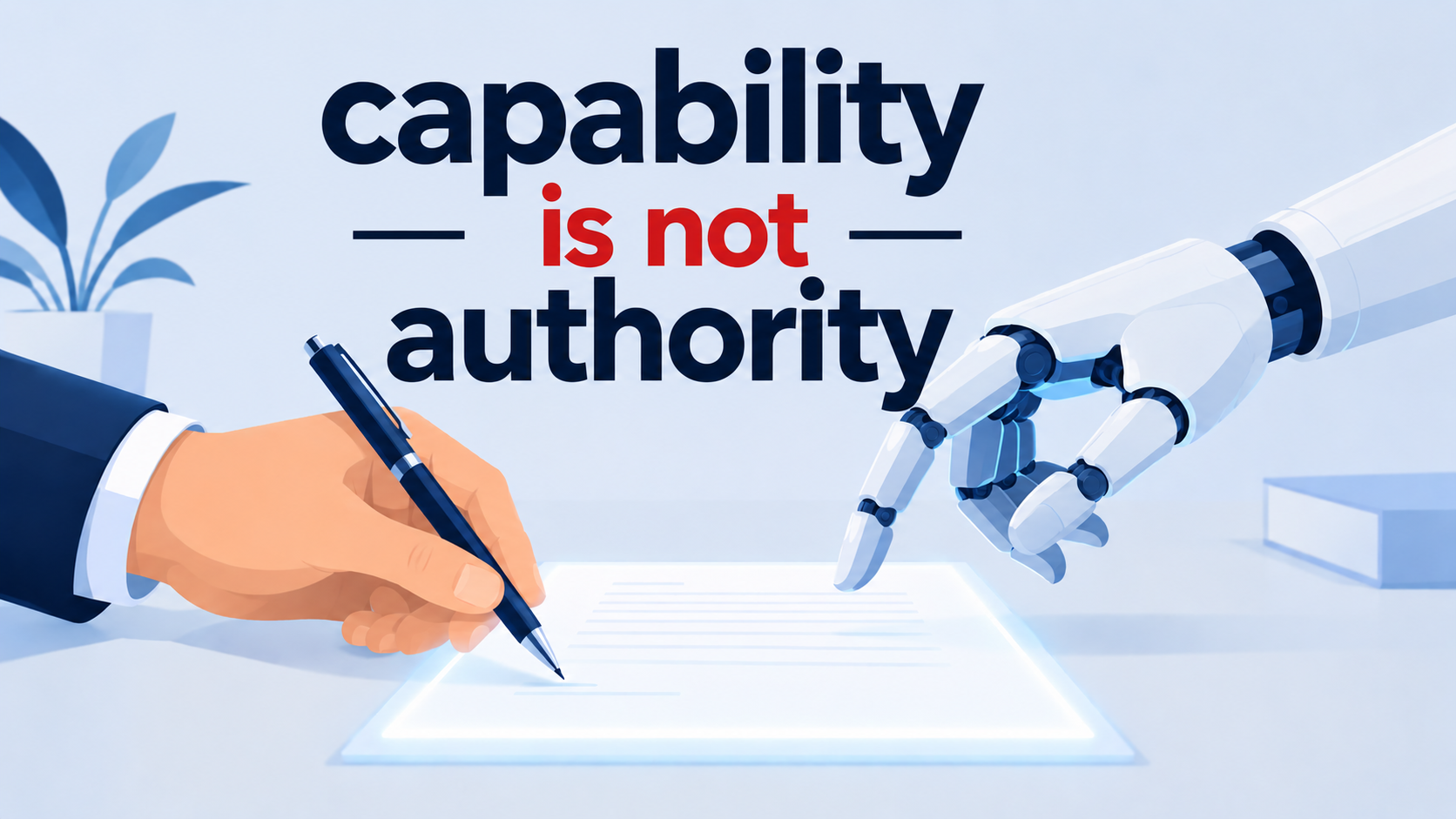
The Model Should Be Your Advisor, Not Your CEO
We gave AI the keys and called it automation. Here's why that's a mistake - and what to do instead.
M
MALIKI
June 1, 2026•5.285 min read
It started with a demo. An AI agent booking flights, replying to emails, deploying code - all in 90 seconds. The crowd clapped. Investors wrote checks. The narrative locked in: the future of AI is agents that just do things. That narrative is seductive. And in 2026, it's quietly breaking things in production. Not because LLMs aren't capable. They clearly are. But we've confused capability with authority - and those are two very different things.
Thing 1: The Model Has No Skin in the Game
An LLM will recommend a rollback with the same confident tone whether it's right or catastrophically wrong. It has no career to lose, no client to face, no consequences to absorb. Your CFO, your engineer, your lawyer - they're accountable. That accountability is what makes judgment work. An LLM has none of that. When you let it decide rather than suggest, you hand responsibility to a system that cannot hold it. > "The best use of an LLM isn't to replace judgment. It's to inform it - faster, wider, and more thoroughly than you could alone." What this means: The model has no skin in the game. Your humans do. Keep the decision where the accountability is.Thing 2: Confident Doesn't Mean Correct
This is what makes LLMs more dangerous than older, dumber automation: they are wrong with perfect confidence. A broken formula throws an error. A rule-based system fails loudly. An LLM invents a legal precedent, hallucinates a source, or misremembers a policy - and delivers it in clean, authoritative prose with zero hesitation. We've already seen it cause real damage. Agents issuing refunds no policy permitted. Coding agents shipping vulnerabilities they themselves approved. Research agents citing papers that don't exist. > "An LLM is the world's most well-read generalist. It has never worked at your company, never met your clients, and will never be fired for a bad call." What this means: Confident tone is a property of the architecture, not a signal of correctness. A human who understands context needs to stand between the model's output and any real-world action.Thing 3: Reversibility Is the Missing Variable
Most teams ask the wrong question when designing agentic workflows. Not "is this task simple?" - not even "is this high-stakes?" The right question is: if the model gets this wrong, can we undo it? Summarize a document? Reversible - let it run. Send the email? Deploy to prod? Charge the card? Those are one-way doors. Once taken, recovery is expensive or impossible.The three modes
Propose - Model drafts options, surfaces risks, recommends a path. Human decides. Almost always safe. Decide - Model commits without review. Fine for low-stakes, reversible, tightly scoped tasks. Nowhere else. Execute - Model acts in the world. This is where autonomy without accountability isn't efficiency - it's liability waiting to be discovered. > "The goal isn't to slow everything down. It's to find the one-way doors and put a human in front of each one." What this means: Reversibility is the missing variable in most AI pipeline designs. Map every agent action against it before deciding how much autonomy to grant.Thing 4: There's a Legal Address on That Accountability Vacuum
When an autonomous AI causes harm, who's responsible? The vendor? The integrator? The developer who wrote the prompt? Without a clear human decision point, everyone has an argument and no one is clearly liable. Regulators noticed. The EU AI Act distinguishes between systems that inform and systems that act. High-stakes autonomous execution is already restricted in healthcare, finance, and hiring - and that's only going to tighten. Propose-first is your paper trail. The org that can show a human approved every consequential action is in a fundamentally different legal position than one that cannot. > "If your AI causes harm and there's no human signature on the decision, you own the entire liability." What this means: Human-in-the-loop isn't just safer engineering. In several verticals, it's already the law. Build for it now or retrofit it under pressure later.Thing 5: Your Best Advisor Isn't Your CEO
The pushback I always hear: "If humans review every step, we lose the speed advantage." Fair concern. Wrong target. Low-stakes, reversible tasks? Let the agent run freely - draft, summarize, analyze, sort. No gate needed. But the moment output triggers an irreversible action in the world, a two-second human confirmation creates asymmetric value that far exceeds the time it costs. The best AI workflows in 2026 follow one pattern: the model does the heavy lifting - research, synthesis, options, risk - and hands a clean proposal to a human who brings what the model structurally cannot have: context, judgment, and genuine accountability for the outcome. > "The best executives in history surrounded themselves with brilliant advisors. None of them handed their advisors the keys." What this means: Propose-first isn't a constraint on AI's value. It's what actually unlocks it - by putting the model where it excels, and keeping humans where they're irreplaceable. ---What You Should Do About It
For developers and AI engineers
- ✅ Classify every agent action by reversibility before you build - design approval gates around the one-way doors
- ✅ Output proposals, not decisions - structured options with tradeoffs, not just a chosen path
- ✅ Log everything consequential - what the model proposed, what the human approved, what ran
For everyone
- ✅ Ask "what's the worst wrong?" before enabling any automation - if it's unrecoverable, add a human step
- ✅ Keep the human signature on anything consequential - that accountability structure protects you legally and operationally
- ✅ Push back on "full automation" narratives - speed matters, so does not deploying at 3 AM because an agent misread a config
The Bottom Line
LLMs are not decision-makers. They're the most capable proposal-generators ever built. Used as advisors - not executives - they create enormous value. The danger isn't the technology. It's the category error: treating a system with no stakes and no accountability as a trustworthy autonomous agent in a world where being wrong has real costs. The model is your advisor. You're still the one who calls the play. Which action in your current AI pipeline would cost the most to undo if the model got it wrong? 🔒Found this useful?
Save it for later or share it with someone who might need it.
Discussion
Share your thoughts on this article.
No comments yet
Start the conversation.