Back to Articles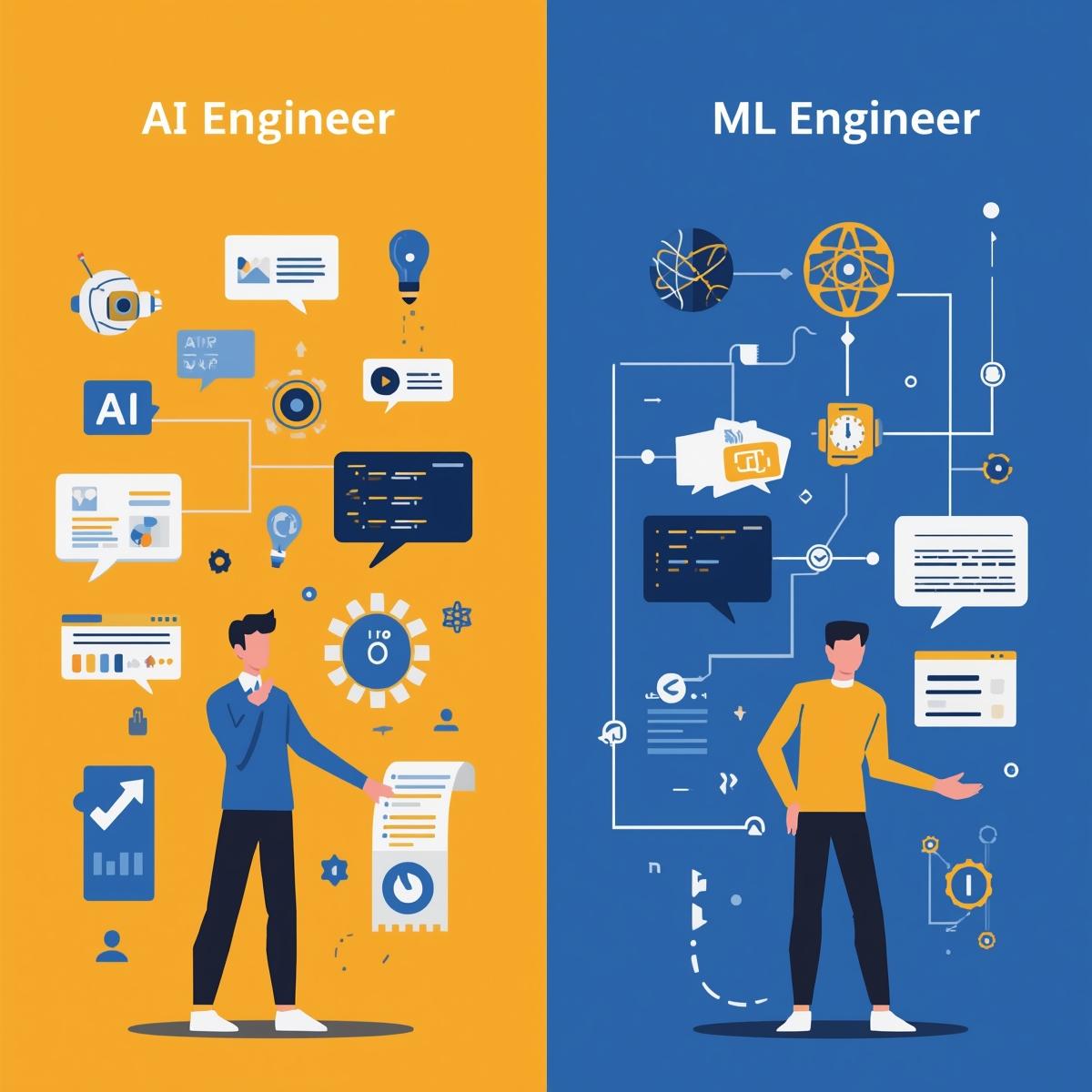
AI vs. ML Engineer: Don't Waste Hundreds of Hours on the Wrong Career Path
Many aspiring tech professionals confuse AI Engineering with Machine Learning Engineering. Understanding the real differences between these roles can save you hundreds of hours and guide your career strategy.
H
Hirely
December 5, 2025•4.93 min read
The Career Confusion Costing You Time
Many aspiring tech professionals use the terms "AI Engineer" and "Machine Learning Engineer" interchangeably. This common confusion is a trap that can cause you to waste hundreds of hours pursuing the wrong skills for the wrong job. The truth is, many people waste time trying to learn AI engineering and ML engineering simultaneously, not realizing these are very different roles and getting stuck in the process. This article breaks down the real, practical differences between these roles to give you the clarity you need to make an informed, strategic decision about your future.Integration vs. Invention: The Core Difference
The primary role of an AI Engineer is to integrate existing models into applications. For example, you might build a system that stores company information in a vector database so employees can cross-reference confidential data faster. Or you could aggregate customer reviews and use a large language model to determine the best next step to improve a product. AI Engineers are builders, focused on using AI to create tools and solutions that solve real-world business problems. This stands in stark contrast to the Machine Learning Engineer, who more often trains models from scratch. This work requires deep, foundational knowledge of mathematics, statistics, and data science to build and validate new models.This Distinction Is Key to Your Career Strategy
AI Engineers need a functional understanding of models-knowing what a model does and how to use its API-not a foundational math perspective. ML Engineers need academic-level expertise in statistics, algorithms, and model architecture. The AI path leverages a software engineer's existing skillset in APIs, data pipelines, and application development, making it far more accessible than starting over in a highly specialized discipline.One Path Is Significantly More Accessible
The hard truth about Machine Learning Engineering is that it involves brutal competition, especially for those without the right academic credentials. You're often competing directly against candidates with PhDs in statistics and computer science, making it a much steeper climb. AI Engineering, however, is a more accessible path for self-taught individuals and those transitioning from other tech roles. It builds directly upon a proven foundation of software development skills. AI Engineers are essentially software engineers with a new superpower. Because traditional coding skills are the bedrock of AI engineering, the learning curve can be significantly shorter. You augment existing software development practices with the new ability to integrate AI models, rather than starting from scratch in a highly specialized, academic field.The Day-to-Day: Product vs. Theory
The daily work of an AI Engineer is highly product-focused and iterative. Their job centers on delivering value to users and measuring impact. A typical task might involve running AB tests in production to see if a feature actually improves user experience. The ML Engineer's work is more theoretical and research-oriented. Their focus is on the model itself, ensuring its integrity and performance before it ever reaches a user. A key activity for them is testing for model bias during validation and training.The Core Difference
AI engineering is about shipping and iterating on products, while ML engineering is about theoretical optimization of models. This fundamental difference affects everything from your daily tasks to your long-term career trajectory.Why AI Engineering Is More Future-Proof Than You Think
There's a persistent fear that AI will eventually make software developer jobs obsolete. However, the AI Engineer role is uniquely positioned to thrive in the future. As AI models become increasingly powerful and ubiquitous, the demand for skilled professionals who can integrate, configure, and manage them will only grow. We will always need engineers who can connect these powerful tools to the systems where they create value, whether that's in Python code, at the infrastructure level, or in the application layer. AI doesn't eliminate the need for engineers-it just changes what we need to build.The Skills You Actually Need
For AI Engineering:
- Strong software development fundamentals
- API integration and data pipeline design
- Understanding of how to prompt and configure models
- Product thinking and user-focused iteration
- Ability to measure and optimize AI features in production
For ML Engineering:
- Advanced mathematics and statistics
- Deep learning architectures and model training
- Data science and experimental design
- Research methodology and paper implementation
- Model validation and bias testing
Making Your Decision
The choice isn't just about skills-it's about mindset: AI Engineering is for the pragmatic builder obsessed with shipping products. You want to see your work in users' hands, iterate based on feedback, and solve real business problems with cutting-edge technology. Machine Learning Engineering is for the rigorous researcher driven by theoretical optimization and mathematical precision. You're fascinated by how models learn, excited by academic papers, and motivated by pushing the boundaries of what's possible.The Bottom Line
Understanding the real differences between AI Engineering and Machine Learning Engineering can save you from wasting hundreds of hours learning the wrong skills for your desired career path. AI Engineers integrate and apply existing models to build products. ML Engineers research and create new models from the ground up. The accessibility, day-to-day work, and required background differ dramatically. The future needs both roles, but you need to choose the path that aligns with your current skills, learning style, and career goals. --- Ready to start your AI engineering journey? Explore our complete roadmap for AI engineers to build the skills that matter. Still deciding between paths? Check out our other career guides on tech roles and career strategies to make the best choice for your future. Now that you understand the real differences, which path are you building towards?Found this useful?
Save it for later or share it with someone who might need it.
Discussion
Share your thoughts on this article.
Checking sign-in status...
Loading comments...