Back to Articles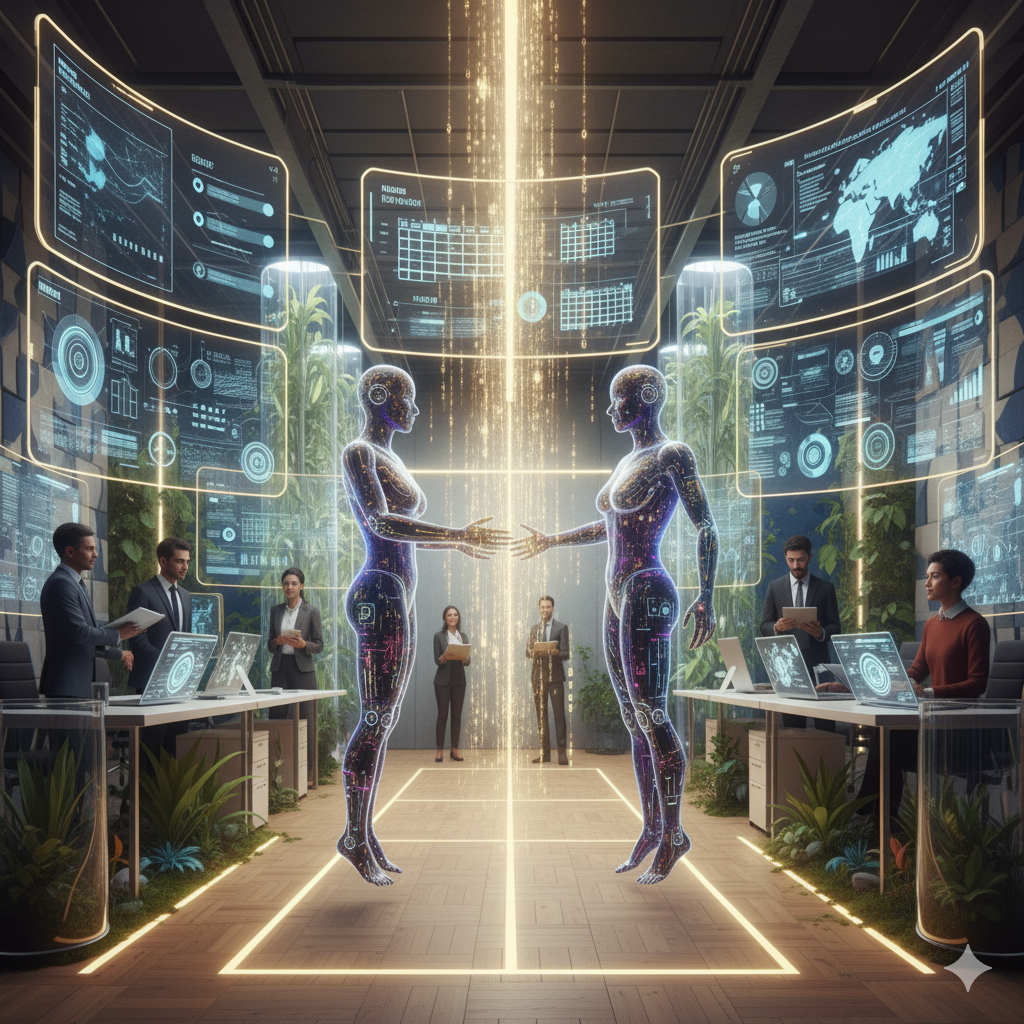
When AI Manages AI: The Future of Autonomous Workplace Coordination
AI agents are learning to coordinate with each other without human intervention. What does this mean for developers, managers, and the future of work organization?
H
Hirely
October 3, 2025•9.65 min read
The Conversation You're Not Part Of
Right now, somewhere in a tech company's infrastructure, two AI systems are negotiating. One is trying to schedule a code review. The other is protecting a developer's focus time. They're exchanging data about priorities, deadlines, and team capacity. They reach an agreement, schedule the meeting, and notify the humans involved. No manager intervened. No project coordinator spent fifteen minutes playing calendar Tetris. The AIs simply coordinated, decided, and executed. This isn't speculation. It's happening today at companies using advanced workflow automation. And it's just the beginning of a profound shift in how work gets organized. Welcome to the era of AI agents managing other AI agents.What Are AI Agents, Really?
Before we dive deeper, let's clarify what we mean by AI agents. An AI agent isn't just a chatbot or a simple automation script. It's software that can perceive its environment, make decisions, and take actions to achieve specific goals with some degree of autonomy. Think of the difference between a thermostat and a smart home system. A thermostat follows simple rules: if temperature drops below 20°C, turn on heating. A smart home AI learns your patterns, predicts when you'll be home, considers energy costs, checks the weather forecast, and coordinates heating, cooling, and ventilation to optimize comfort and efficiency. In the workplace, AI agents might handle tasks like monitoring project health and flagging risks, routing support tickets to appropriate team members, scheduling meetings based on priority and availability, managing resource allocation across projects, or coordinating deployments across different systems. The key characteristic is autonomy within defined boundaries. These aren't tools waiting for commands-they're systems actively working toward goals.When Agents Start Talking to Each Other
The real transformation happens when these AI agents begin coordinating with each other, creating what researchers call multi-agent systems. Instead of each agent operating in isolation, they communicate, negotiate, and collaborate. Here's a concrete example from a software development workflow. Your testing AI agent detects a critical bug in the staging environment. Instead of simply alerting humans, it initiates a cascade of coordinated actions. It communicates with the deployment agent to halt the upcoming production release. It contacts the project management agent to automatically reschedule dependent tasks. It works with the calendar agent to find emergency debugging time for the relevant developers. It notifies the client communication agent to prepare stakeholder updates. All of this happens in seconds, without a single human making a decision. The agents aren't replacing human judgment on whether to fix the bug or how to fix it. They're handling the operational coordination that would normally require hours of emails, Slack messages, and meeting interruptions.The Three Layers of Agent Coordination
To understand how this works in practice, it helps to think of AI agent coordination in three layers, each building on the previous one. The first layer is simple task handoffs. One agent completes its work and passes results to another. Your calendar agent schedules a meeting, then hands that information to your note-taking agent, which prepares a meeting agenda based on project context. This is relatively straightforward and already common in modern workflow tools. The second layer involves negotiation and optimization. Agents actively communicate to find optimal solutions. Your calendar agent wants to schedule a team meeting, but it needs to negotiate with multiple individual calendar agents representing team members. Each agent has its own priorities and constraints. They exchange proposals, counterproposals, and eventually reach consensus on timing that works for everyone. The third and most sophisticated layer is emergent coordination. Agents develop strategies and workflows that humans never explicitly programmed. Multiple agents observe patterns, share learnings, and collectively optimize processes in ways that surprise even the developers who built them. This is where it gets both exciting and slightly unsettling.Real-World Examples Emerging Today
This might sound futuristic, but early versions are already operational in various industries. In customer service operations, routing agents coordinate with language processing agents and knowledge base agents to resolve customer inquiries. When a complex issue arrives, these agents automatically assess it, determine the right expertise needed, check agent availability and workload, escalate if necessary, and prepare relevant context for the human who handles it. Financial trading systems use coordinating AI agents extensively. Market analysis agents share insights with risk assessment agents, which coordinate with trading execution agents, all operating within parameters set by human traders and risk managers. The agents make thousands of micro-decisions per second that would be impossible for humans to coordinate manually. In logistics and supply chain management, AI agents coordinate truck routing, warehouse inventory, delivery schedules, and customer notifications. When unexpected delays occur, the agents automatically reorganize the entire system to minimize impact. Even in creative industries, we're seeing coordination between AI agents. Content generation agents work with editing agents, fact-checking agents, and distribution agents to produce and publish content with minimal human intervention beyond initial creative direction.What This Means for Moroccan Tech Companies
For Morocco's growing tech sector, particularly companies doing outsourcing and nearshore development for European clients, AI agent coordination presents both opportunities and challenges. The immediate opportunity is operational efficiency. Moroccan tech companies often juggle multiple client projects simultaneously, each with different requirements, timelines, and communication preferences. AI agent systems can handle much of the coordination overhead, allowing human managers to focus on higher-value activities like client relationships, technical problem-solving, and team development. Consider a typical scenario at a Moroccan software house. You're managing three client projects in different European countries, each in different time zones, with teams split between Casablanca, Rabat, and remote developers. Currently, coordination is a daily headache of scheduling conflicts, resource allocation puzzles, and constant context switching. With coordinating AI agents, much of this disappears. Project management agents coordinate with calendar agents to automatically schedule meetings at optimal times for all parties. Resource allocation agents monitor workload across projects and suggest rebalancing when developers are over or under-utilized. Communication agents translate and route information to appropriate stakeholders based on project context and urgency. This doesn't eliminate management-it elevates it. Instead of spending hours on coordination logistics, managers can focus on strategic decisions, mentoring developers, and building client relationships.The New Skill: Agent Orchestration
As AI agents become more autonomous and begin coordinating with each other, a new skill becomes critical for developers and managers: agent orchestration. This isn't traditional programming. You're not writing code that tells the system exactly what to do in every situation. Instead, you're defining goals, constraints, and guidelines, then allowing agents to figure out how to achieve objectives within those boundaries. Think of it like the difference between micromanaging and leadership. A micromanager tells people exactly what to do, when to do it, and how to do it. A leader sets clear objectives, provides resources and support, then trusts the team to determine the best approach. Agent orchestration requires similar thinking. You need to clearly define what you want agents to achieve, set appropriate boundaries and constraints, establish escalation criteria for when human judgment is needed, monitor agent behavior and adjust parameters, and understand when to intervene versus when to let agents coordinate. For Moroccan developers, this represents a significant opportunity. Those who develop expertise in designing, deploying, and managing multi-agent systems will be highly valuable in the global market. It's a skill set that combines technical knowledge with strategic thinking and system design.The Questions We Need to Answer
While the potential benefits are clear, AI agents coordinating with each other also raise important questions that organizations need to address. First is the question of accountability. When multiple AI agents coordinate to make decisions, who's responsible if something goes wrong? If an agent coordination chain leads to a missed deadline or a customer service failure, how do we trace responsibility and learn from mistakes? Then there's transparency. When agents negotiate and coordinate automatically, how do humans maintain visibility into what's happening? How much autonomy is appropriate, and when should coordination require human approval? There are also concerns about emergent behavior. When AI agents coordinate in sophisticated ways, they might develop strategies or approaches that humans didn't anticipate. This could be beneficial, but it could also lead to unexpected problems. How do we ensure agent coordination remains aligned with organizational goals and values? Security is another critical consideration. If agents are communicating and coordinating automatically, those communication channels become potential attack vectors. How do we secure multi-agent systems against manipulation or interference?The Human Element Remains Central
Despite all this automation and coordination, one thing remains absolutely certain: human judgment, creativity, and oversight are more important than ever. AI agents managing other AI agents doesn't mean humans become irrelevant. It means humans can focus on what we do best: strategic thinking, creative problem-solving, empathy and relationship building, ethical judgment, and handling ambiguity and novel situations. The most successful organizations won't be those that implement the most agent automation. They'll be the ones that find the right balance between AI coordination and human oversight, creating systems where agents handle operational complexity while humans focus on strategic direction.Preparing for the Coordinated Future
If you're a developer or tech professional in Morocco, how should you prepare for this shift toward coordinating AI agents? Start by getting hands-on experience with existing agent systems and workflow automation tools. Experiment with how different tools can work together. Build small projects where multiple AI systems coordinate to achieve goals. Study system design and architecture. Understanding how to design systems where multiple components interact autonomously is crucial. This isn't just software engineering-it's systems thinking. Develop your strategic thinking abilities. As agents handle more operational coordination, human value increasingly comes from strategic decision-making, creative problem-solving, and navigating complex situations that don't have clear answers. Stay informed about AI developments, particularly in the areas of multi-agent systems, agent communication protocols, and autonomous decision-making. This field is evolving rapidly, and understanding the trajectory helps you stay ahead. Most importantly, think about the ethical implications. As you build or deploy systems where AI agents coordinate autonomously, consider questions of accountability, transparency, fairness, and human oversight. The technical ability to build these systems comes with responsibility for their impact.Looking Ahead
We're in the early stages of a fundamental shift in how work gets organized and coordinated. AI agents managing other AI agents isn't a distant future-it's an emerging reality that will reshape workplaces over the next few years. For Morocco's tech sector, this presents an opportunity to leapfrog traditional organizational structures and embrace more efficient, scalable ways of working. Companies that master agent coordination early will have significant competitive advantages in serving global clients. But this transition also requires thoughtfulness. We need to develop these systems in ways that enhance human capability rather than diminish human agency. We need to maintain oversight and accountability while enabling autonomy and efficiency. We need to ensure that coordination between AI agents serves human goals and values. The future of work isn't humans versus AI. It's humans and AI working together, with AI agents increasingly handling the coordination and operational complexity that currently consumes so much human time and energy. The question isn't whether this transformation will happen-it's happening now. The question is whether we'll shape it thoughtfully or simply react to it as it unfolds. For developers, managers, and tech leaders in Morocco and around the world, now is the time to engage with these technologies, experiment with their possibilities, and help guide their development in directions that benefit everyone. The AI agents are already coordinating. Are you ready to orchestrate them?Found this useful?
Save it for later or share it with someone who might need it.
Discussion
Share your thoughts on this article.
Checking sign-in status...
Loading comments...